CRAZY HIPPO FACTS
The hippopotamus, also known as the river horse, is the third-largest land animal and is considered one of Africa’s most formiddable large animals. Read more about these amazing creatures in our blog below…plus, watch two new camera trap videos of hippos on the Greater Ukuwela Nature Reserve!
All photographs were taken at Wild Tomorrow’s Greater Ukuwela Nature Reserve by Wild Tomorrow’s Wildlife Storyteller, Chantelle Melzer.
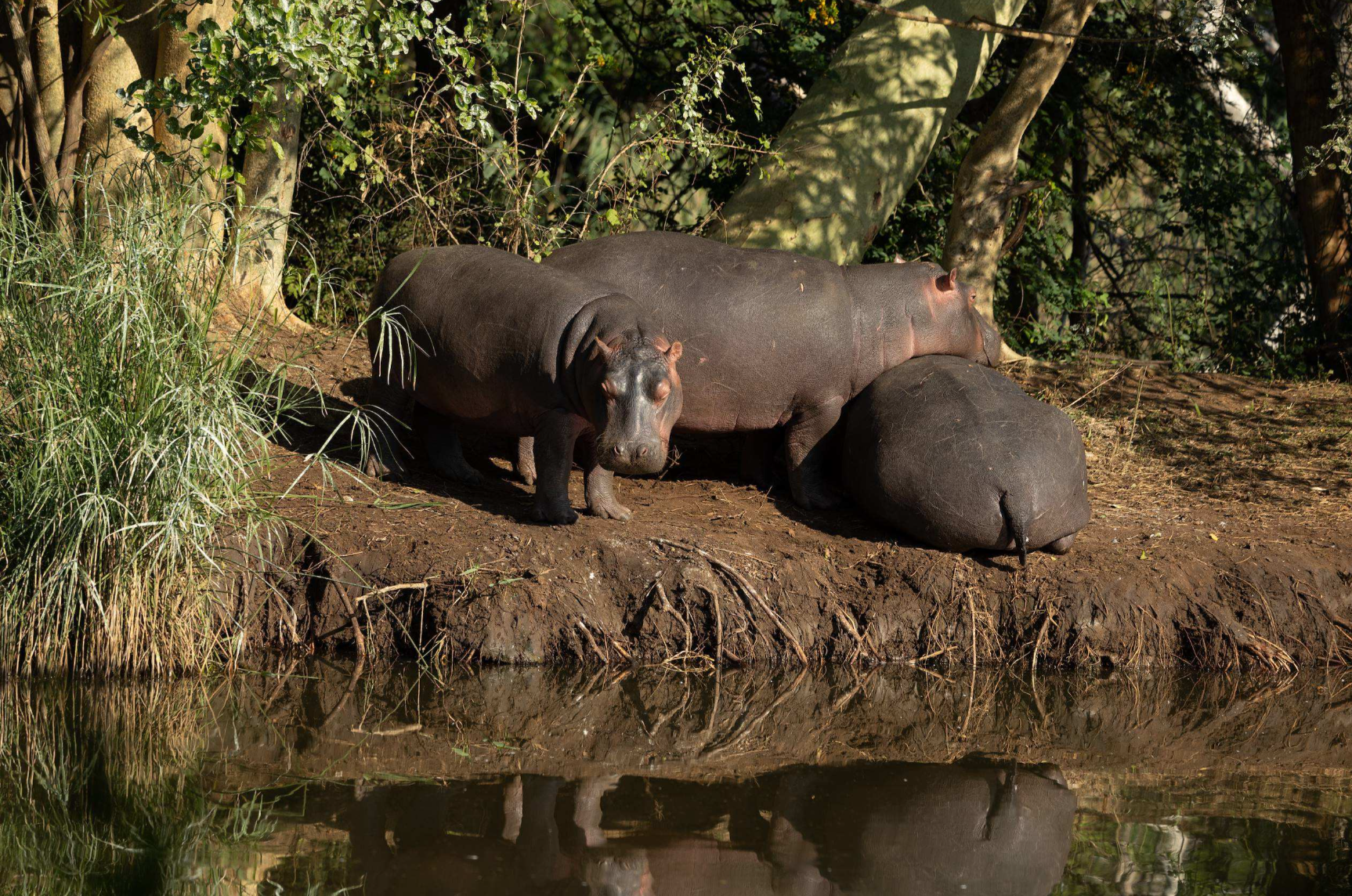
Hippos on the bank of the Mzinene River bordering Wild Tomorrow’s Greater Ukuwela Nature Reserve.
LIFE IN THE WATER
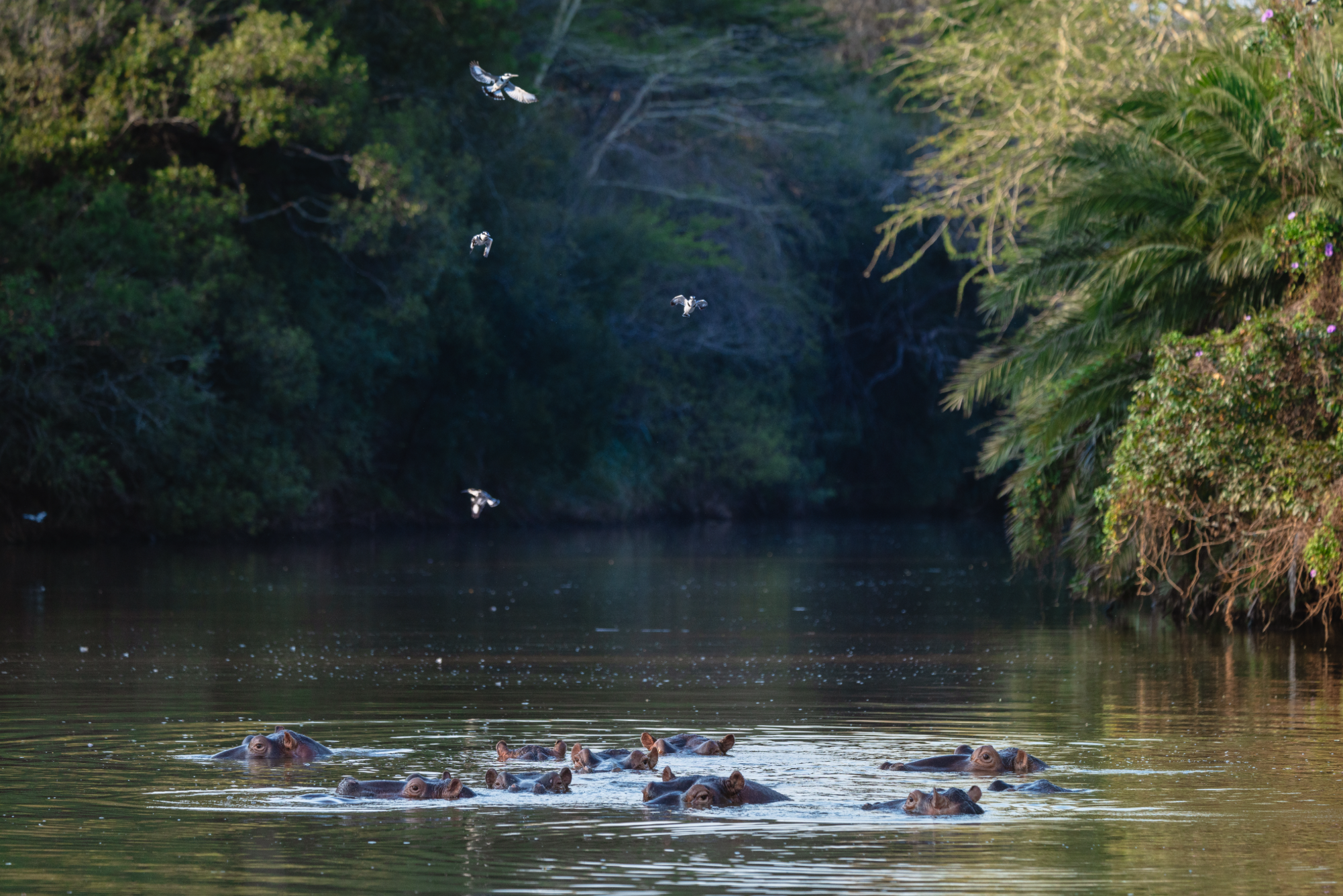
The hippos' closest relative is the whale and porpoise; therefore, hippos are most often found in water. Although they spend most of their time in water, they are actually semi-aquatic animals, spending roughly half their lives in the water and half on land. Although they’re mostly seen in water they don’t actually swim; they walk, bounce, or run along the riverbed. Their bodies are dense and not buoyant like other marine animals, so they stay submerged but push off the bottom to move forward, which is why you'll never find them in deep water.
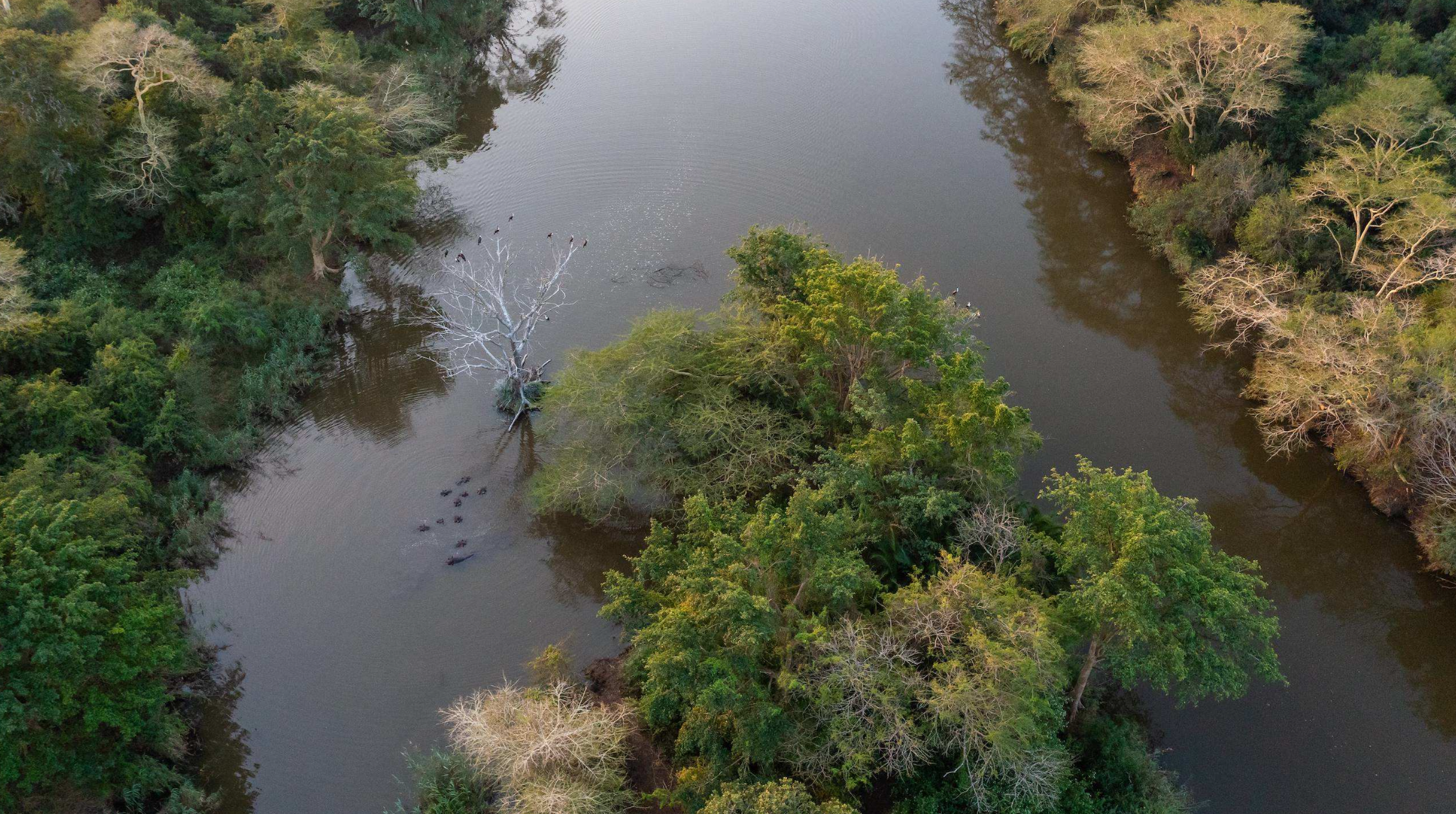
Can you spot the pod of hippos in this photo?
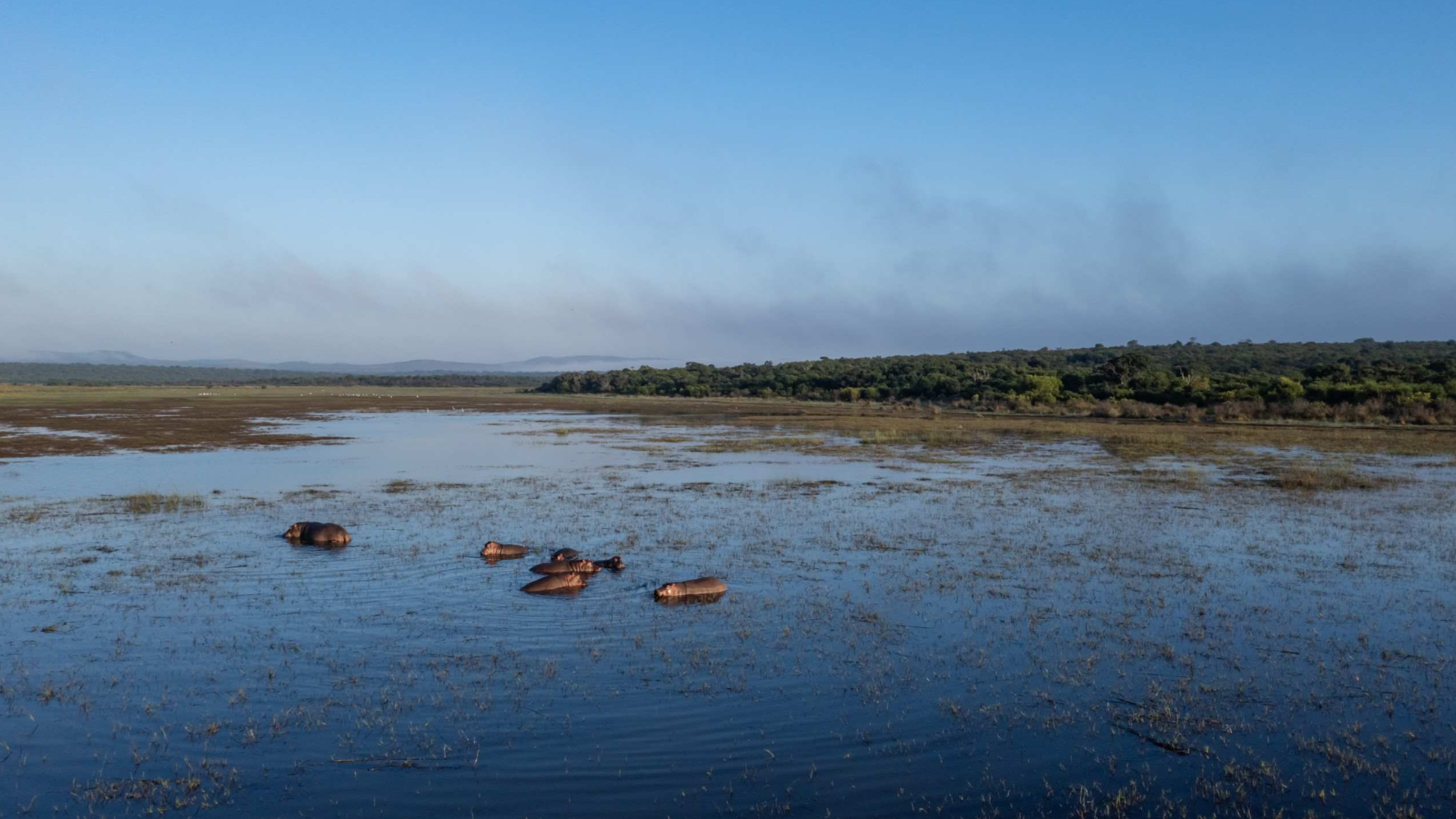
Hippos eyes, ears, and nostrils are located on the top of their heads, allowing them to see, hear, and breathe while mostly submerged. They sleep fully underwater and can close their ears, and nostrils automatically, keeping water out. This is how calves are able to suckle underwater. Although they sleep underwater, they instinctively bounce to the surface to breathe, without waking up.
Hippos may have very thick skin, but it is surprisingly sensitive and can easily be damaged by the sun. Water helps protect their skin, and they also secrete an oily red substance that acts as a natural moisturizer and sunscreen. While the oily red substance may look like blood…it’s a built-in skin protectant!
Hippos are master divers and can hold their breath for up to five minutes. Despite their enormous size, they move remarkably well through water, propelling themselves off the riverbed rather than swimming in the way that most aquatic animals do. They can also run up to 30 miles per hour in short bursts on land. In fact, only Usain Bolt (the fastest man alive!) might have a chance of outrunning a hippo!
ONE OF THE MOST DANGEROUS ANIMALS IN AFRICA
Hippos can be extremely aggressive when they feel threatened, and their immense strength makes them one of Africa's most dangerous animals. Their mouths can open to an astonishing 180 degrees, and their bite force is nearly three times stronger than that of a lion. An open mouth is not a yawn, but a sign of warning. You will only see a hippo do this while in the water because that is the only time they are territorial, accompanied by them, "honking” and "grunting". On land at night, they will peacefully share grazing paths.
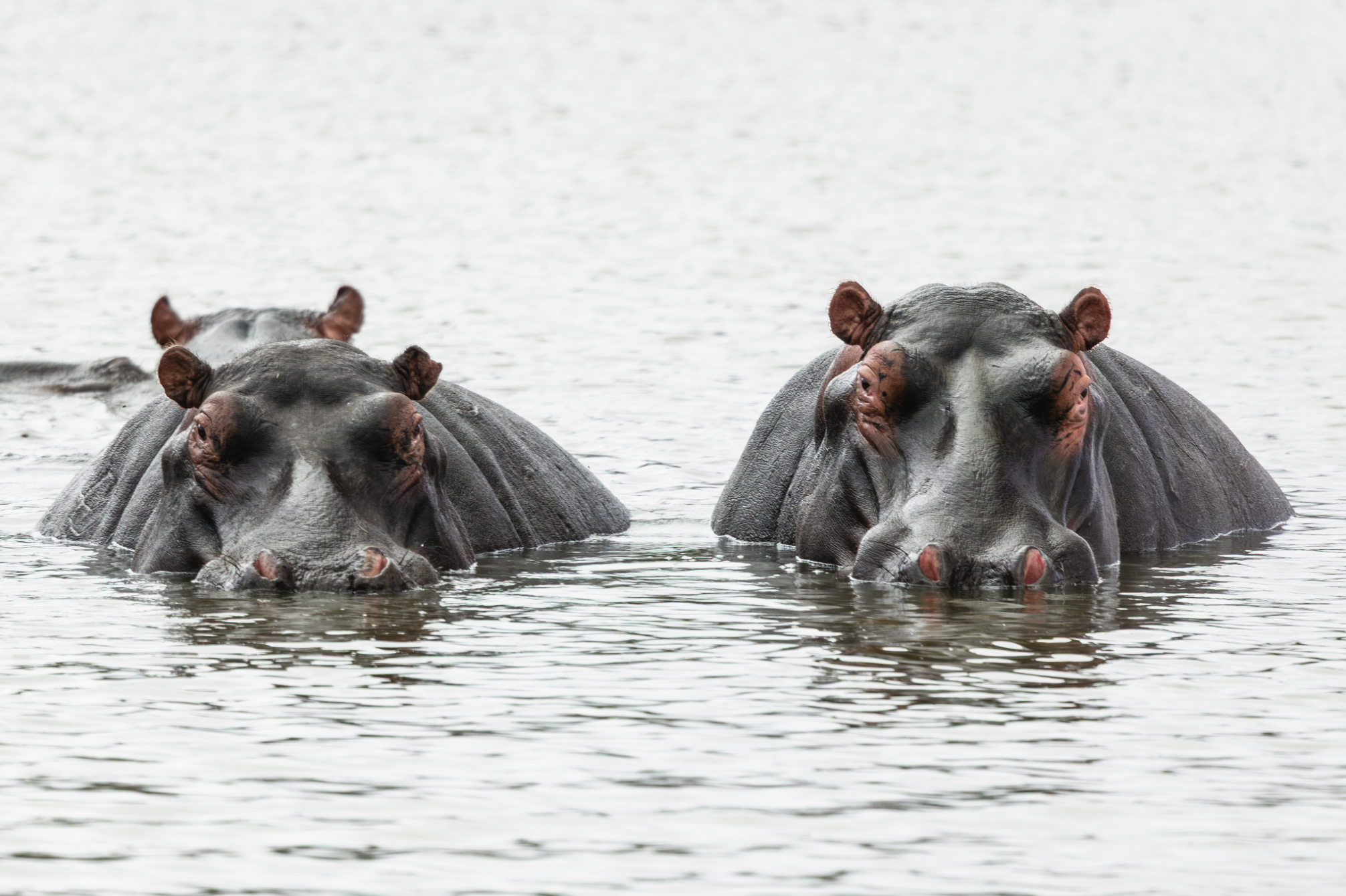
If a predator - or even a human - gets too close, a hippo may charge without warning. While lions, crocodiles, and hyenas sometimes prey on young or vulnerable hippos, an unsuccessful attack can leave the predator with serious injuries.
HIPPO POD DYNAMICS
Compared to many other African animals, hippos are remarkably long-lived. They can live up to 40 years in the wild and even 50 years in captivity.
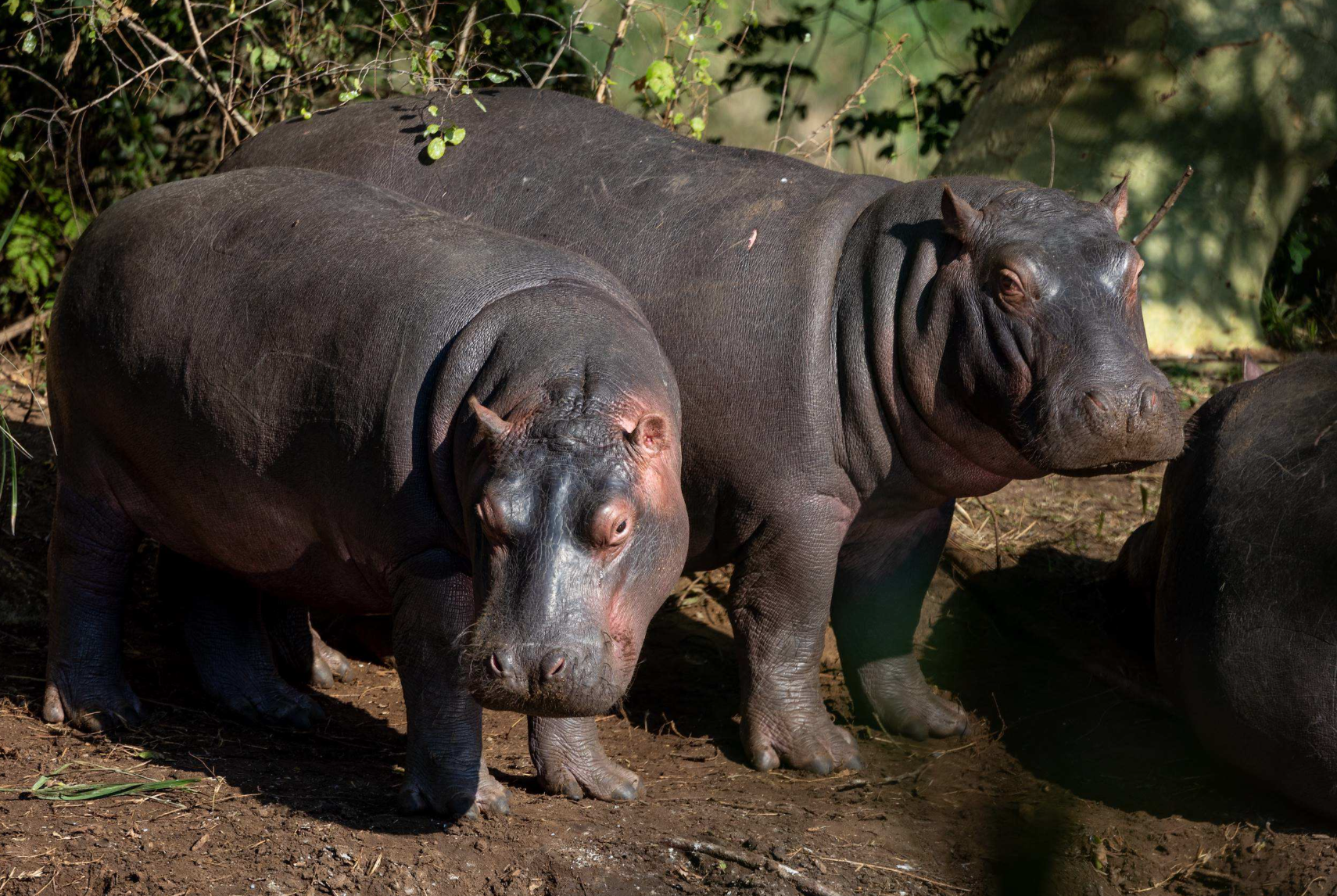
A group of hippos is called a pod, herd, or bloat and usually consists of 10 to 20 individuals led by a dominant male. The dominant male fiercely protects his territory and the females within his pod.
To warn off rivals, males put on impressive displays. They open their mouths wide to show off their long, curved canines, make loud grunting noises, and splash dramatically in the water. If that doesn't work, they have another, far less pleasant tactic: flinging dung by rapidly spinning their tails. It's messy, but it gets the message across!
Female hippos are incredibly attentive mothers. They typically give birth to a single calf every two years, and the calf may remain with its mother until it is around seven years old. After giving birth, mothers and calves often gather together in groups, providing extra protection through safety in numbers.
HIPPO DIET
Hippos are most active at night, leaving the safety of the water to search for food. They are herbivores, and grass is their favorite meal.
A hippo may travel up to five miles in a single night to find the right grazing spot. Males can weigh up to 9,920 pounds, while females average around 3,000 pounds, so they need plenty of food to maintain their massive size. In just one night of feeding, a hippo can consume up to 110 pounds of grass.
ECOSYSTEM ENGINEERS
Hippos play a vital role in maintaining healthy ecosystems and are considered ecosystem engineers.
As they travel between water and grazing areas, their massive bodies create pathways that other animals use to move through dense vegetation. Their presence also benefits aquatic ecosystems. When hippos defecate in rivers and wetlands, their dung provides nutrients that support fish, plants, and countless other species.
However, this natural process depends on healthy, flowing waterways. As climate change and human development alter water systems, waterways can become stagnant. When this happens, nutrients become concentrated in one area instead of being dispersed naturally, which can negatively impact other species and upset the balance of the ecosystem.
Protecting intact river systems like the Mzinene River is an important part of ensuring hippos and countless other species continue to thrive in the Greater Ukuwela Nature Reserve.
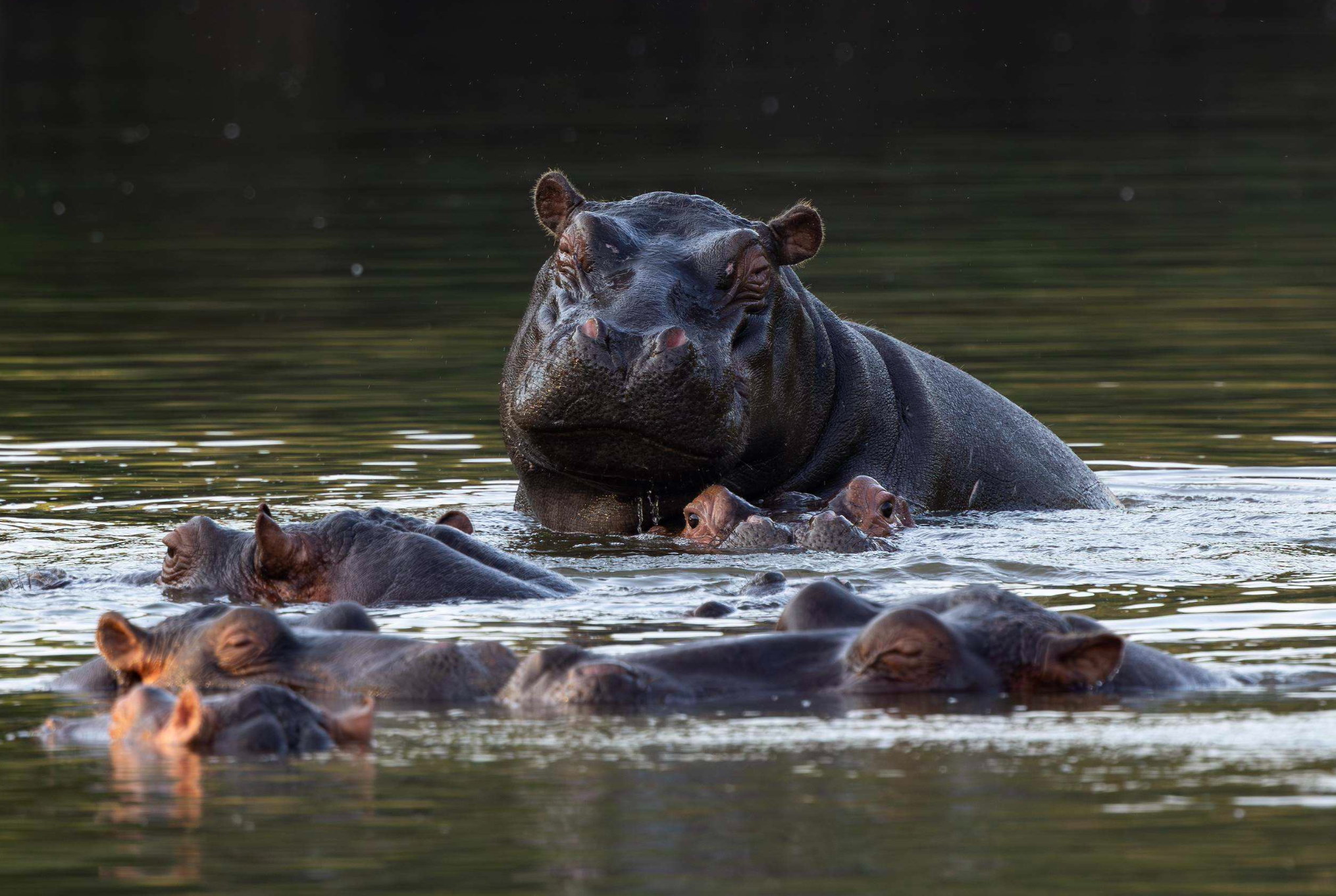
The pod of hippos checking out Wild Tomorrow’s Wildlife Storyteller, Chantelle Melzer, as she snaps this photograph!
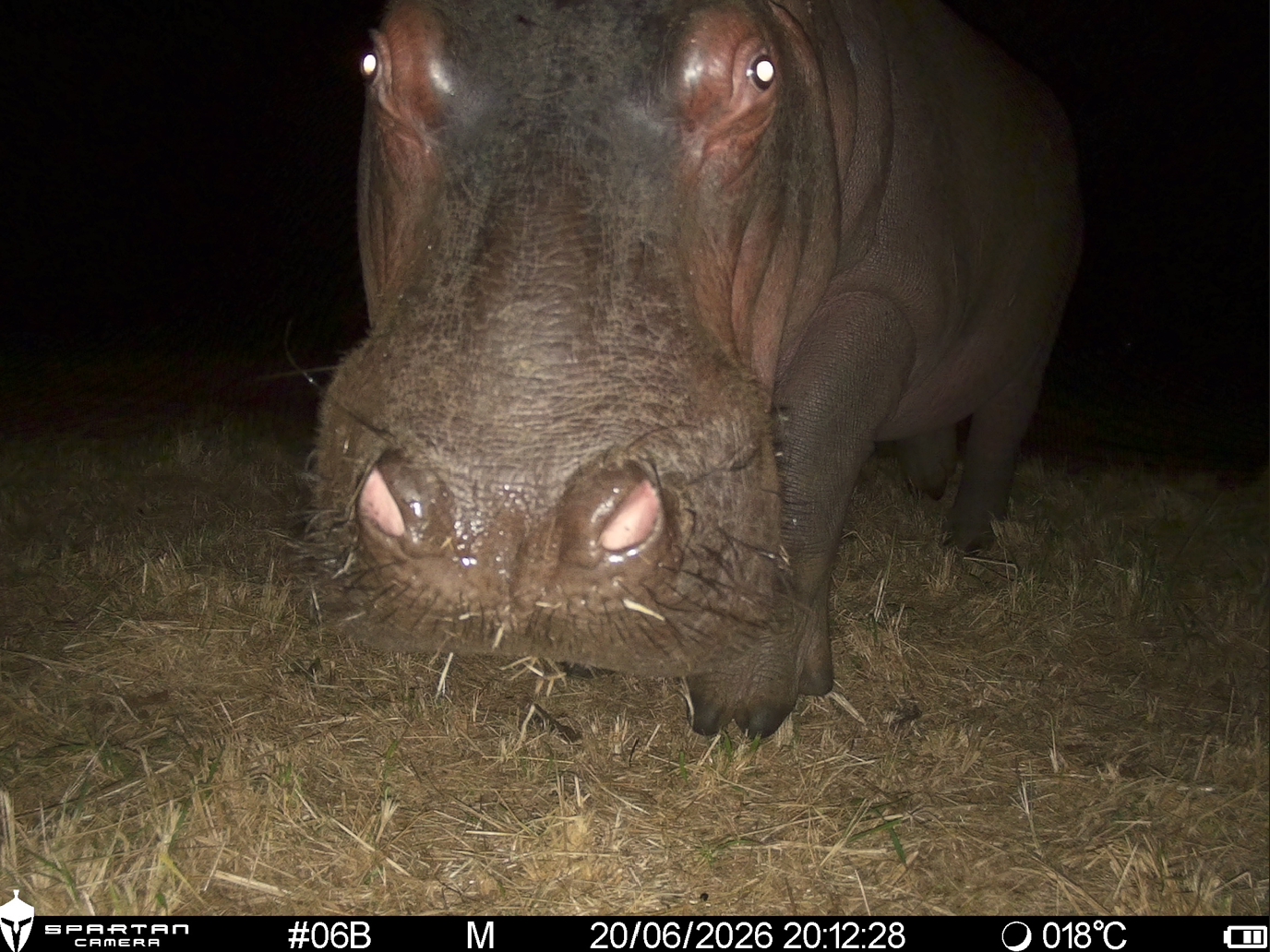
Hippo caught on a camera trap at the Greater Ukuwela Nature Reserve.
HOW CLIMATE CHANGE AFFECTS HIPPOS
Climate change impacts all species, even those that may seem resilient.
According to the IUCN Red List, hippos are considered Vulnerable, meaning they face a high risk of extinction in the wild if current threats continue. Historically, hippos were found across much of Africa, but their range has shrunk significantly due to habitat loss, human activity, and environmental changes.
One of the greatest threats to hippos is habitat degradation. Because they rely heavily on water to regulate their body temperature and protect their sensitive skin, droughts can have devastating consequences. As water sources shrink, hippos are forced into smaller areas, increasing competition for resources and conflict with humans.
Although hippos do not receive as much attention as rhinos or elephants when it comes to poaching, they are still targeted for their teeth, ivory-like canines, skin, skulls, and bushmeat.
HIPPOS ON WILD TOMORROW’S GREATER UKUWELA NATURE RESERVE
Now that you're a hippo expert…check out our camera trap footage of hippos on the Greater Ukuwela Nature Reserve!
And can we talk about that calf? Isn't it absolutely adorable?
HELP PROTECT WILDLIFE LIKE HIPPOS
By supporting Wild Tomorrow, you're helping protect and restore critical habitat in the Greater Ukuwela Nature Reserve, ensuring species like hippos continue to thrive for generations to come.
RESOURCES
“Hippos are one step closer to Endangered Species Act protections.” Humane World For Animals, 20 March, 2023, https://www.humaneworld.org/en/news/hippos-are-one-step-closer-endangered
“Hippopotamus.” National Geographic Kids, 14 March, 2014, https://kids.nationalgeographic.com/animals/mammals/facts/hippopotamus
“Hippopotamus.” National Geographic,10 March, 2011, https://www.nationalgeographic.com/animals/mammals/facts/hippopotamus
“The IUCN Red List of Threatened Species.” IUCN Red List , www.iucnredlist.org/. Accessed 10 June 2026.