WORLD LION DAY 2026: HOW ARE THEY DOING NOW?
World Lion Day is a day to celebrate lions and to raise awareness of the conservation plight facing one of nature’s most revered (and feared) predators. Learn more about African lions and how their conservation status has changed in the past two years – and what is critical to improving their story in the future.
Watch our video campaign raising awareness about lion conservation for #WorldLionDay2026.
In 2024, we wrote about the crisis facing Africa's lions: World Lion Day 2024. Two years on, we wanted to sit with that same question again: how are they now? The answer is mixed — some ground held, some lost, and one truth that hasn't moved an inch.
The population is about the same. Still roughly 20,000–25,000 lions left in the wild — fewer than fit in a mid-sized football stadium, scattered across an entire continent. No recovery, but no sudden collapse either. Lions are holding on, one pride at a time, at crisis levels.
Their world, though, keeps shrinking. In 2024, lions occupied 8% of their historical range. It's now closer to 6%. Two percentage points might sound small, but picture it as a map slowly being erased at the edges — a little more wilderness fenced off, farmed over, or built on every year, leaving lions with less and less room to exist

A gorgeous lion cub by our Ambassador, Martin Meyer @martinmeyer_wild
Something else has shifted since 2024. Back then, every lion on the continent shared one label: "Vulnerable." Now scientists assess them in two separate groups, and the difference between them is stark. East and Southern Africa's lions are still categorised as Vulnerable, and in some well-funded reserves, they're actually holding steady or even growing (a rare bright spot!). However, West and Central Africa's lions are facing devastation: they're now officially categorized as Endangered, with fewer than 250 individuals left, most clustered into a single shared park spanning Benin, Burkina Faso, and Niger. We can now see that this is one species with two very different futures.
Since 2024, one number hasn't budged at all: lions are still extinct in 26 countries. They now survive in only about 18 African countries.
WHAT IS ACTUALLY DRIVING THE DECLINE?
A few threats keep coming up again and again. Habitat loss and fragmentation lead the list — farming, settlements, and roads keep shrinking wild land and cutting populations off from one another, scattering what used to be a connected wilderness and ecosystem. Human-wildlife conflict follows close behind, as lions are often killed in retaliation for attacks on livestock — a tragedy on both sides of that encounter. Prey depletion, driven largely by bushmeat poaching, quietly starves lions out even when no one is hunting them directly; snares set for other animals kill lions too, and fewer prey means less food to go around. Poaching body parts adds another layer, fueling a growing trade in bones, claws, and skins. Underfunded protected areas compound all of it — well-funded reserves see stable populations, while underfunded ones see steady, quiet losses (that’s why campaigns like our annual World Ranger Day, are so important – equipping rangers who protect all wildlife within the reserves their charged with protecting). And then there's genetic erosion: isolated populations, like Tanzania's Ngorongoro Crater lions, are inbreeding and accumulating harmful mutations simply because they have nowhere new to roam and no fresh blood to welcome in.
Nearly every one of these threats traces back to the same root cause: not enough connected, well-protected space.
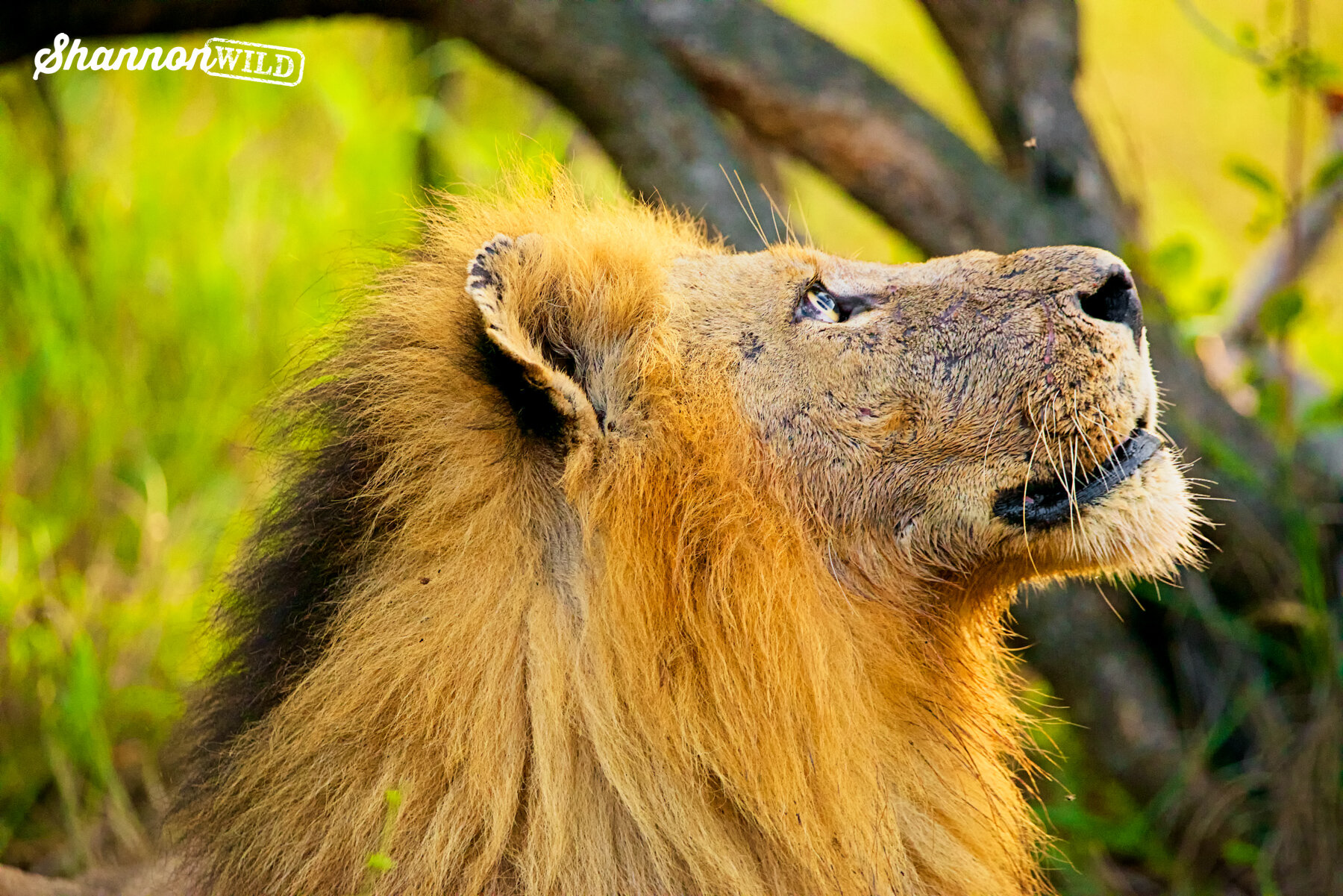
African male lion gazing upward. By Wild Tomorrow Ambassador Shannon Wild @shannon__wild
So, how are things two years later? Lions still need connected, protected space and real funding to support the operations of their reserves. Where reserves are well-managed, lions are doing okay. Everywhere else, they're vanishing a little more each year, until one day a country that used to have lions simply doesn't anymore.
That's why Wild Tomorrow's focus is protecting habitat to make sure wild spaces remain wild, or are restored and re-wilded. Loss of habitat isn't a slow background issue; it's an emergency for wildlife and the greater health of the planet, happening right now. Wild Tomorrow is committed to working toward a future where wildlife thrives in KwaZulu-Natal by linking wild land and protecting it, so lions have room to roam and roar again.
To support Wild Tomorrow’s work to protect lions and expand habitat, please consider making a donation.

A lioness and her cubs, Kenya. Photo by our Ambassador, Nadja Rutkowski @lpgfilms.
References
Bauer, H., Packer, C., Funston, P.F., Henschel, P. & Nowell, K. 2016. Panthera leo (errata version published in 2017). The IUCN Red List of Threatened Species 2016: e.T15951A115130419. http://dx.doi.org/10.2305/IUCN.UK.2016-3.RLTS.T15951A107265605.en.
Bauer, H., Chapron, G., Nowell, K., Henschel, P., Funston, P., Hunter, Luke T.B., Macdonald, D. & Packer, C. Lion (Panthera leo) populations are declining rapidly across Africa, except in intensively managed areas. PNAS December 1, 2015 112(48) 14894-14899. https://doi.org/10.1073/pnas.1500664112
Lindsay, P.A. et al. The performance of African protected areas for lion and their prey. Biological Conservation Volume 209, May 2017, Pages 137-149.https://doi.org/10.1016/j.biocon.2017.01.011
Lindsay, P.A. et al. More than $1 billion needed annually to secure Africa’s protected areas with lions. PNAS November 6, 2018 115(45) E10788-E10796 https://doi.org/10.1073/pnas.1805048115